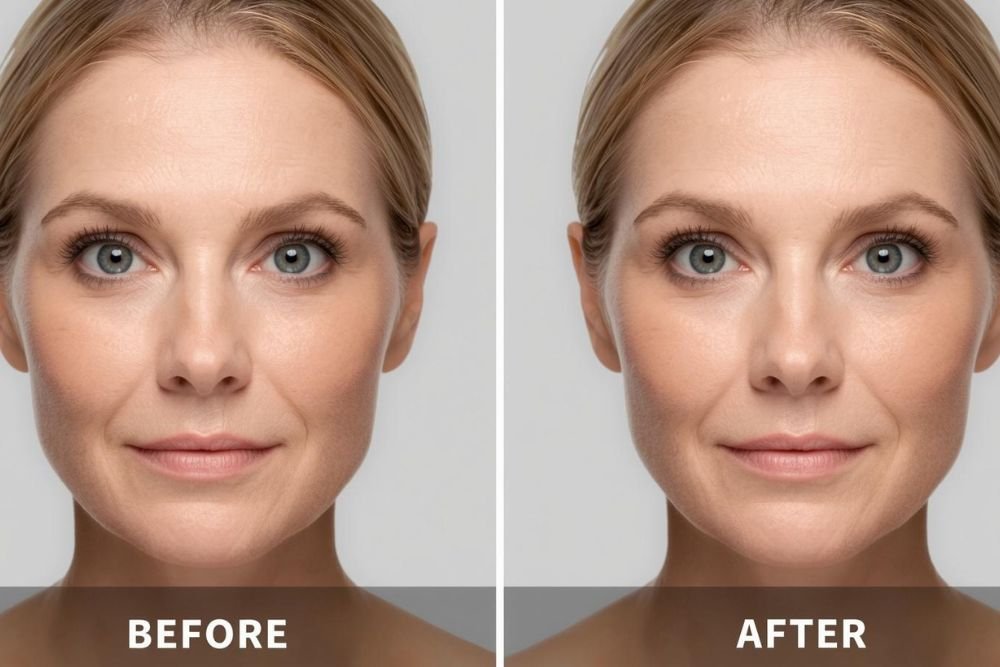
The “Filler Fatigue” Epidemic: Why Your Old Filler Might Be Making You Look Older
For nearly two decades, the aesthetic industry operated under a simple “inflation” model: if there is a wrinkle, fill it. However, as we move through 2026, a new patient demographic has emerged—the over-filled patient. At Ziva Wellness, we call this “Filler Fatigue.”
Many patients find that despite continuous injections, they look tired, “puffy,” or simply “not like themselves.” The reality is that traditional Hyaluronic Acid (HA) fillers often last much longer than the 6–12 months previously advertised, and over time, they can migrate.
Understanding Filler Migration and "Pillow Face"
Filler doesn’t always dissolve on its own; sometimes, it travels. When filler moves from the deep tissue to the superficial layers, it creates a heavy, distorted appearance.
The “Tyndall Effect”:A bluish tint under the eyes caused by misplaced filler.
The “Moustache” Look:Filler migrating above the lip border.
Volume Displacement:Cheeks that look “rounded” only when smiling, creating a shelf-like appearance.
At Ziva Wellness, Dr. Vini Singh utilizes High-Frequency Doppler Ultrasound to visualize exactly where your old filler is sitting. We don’t guess; we map.
The Ziva "Clean Slate" Protocol
Before we add new volume, we often recommend a “Reset.” Using Hyaluronidase (an enzyme that breaks down HA), we precisely dissolve migrated or lumpy product.
The Goal: To restore your natural anatomy. Once the “puffy” canvas is cleared, we transition you to Regenerative Biostimulators like PDRN (Salmon DNA) or Calcium Hydroxylapatite (CaHA). These don’t just “fill” a hole; they tell your body to build its own type-1 collagen, providing a lift that is structural, sharp, and authentically you.
CTA: Does your face feel “heavy” or “puffy”? Book a Filler Mapping Consultation at Ziva Wellness and let’s rediscover your natural structure.